What is CVT?
CVT stands for Continuously Variable Transmission, and it’s a type of transmission system found in some cars. Now, if you’ve ever driven a traditional car, you’re probably familiar with automatic or manual gearboxes. The big difference with CVT is that it doesn’t use gears in the same way. Instead of shifting between set gears like “Park,” “Drive,” or “Reverse,” the Continuously Variable Transmission works seamlessly without those noticeable shifts.
So, imagine the car never having to “decide” what gear it needs to be in. It can adjust and change continuously to the optimal ratio. This smooth, uninterrupted motion means no jarring gear shifts as you accelerate or decelerate. Pretty cool, right?
How does a CVT work?
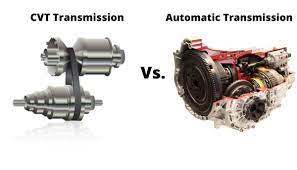
Let’s get into how it works. Instead of traditional gears, the CVT system uses a pair of pulleys connected by a belt or chain. One pulley is connected to the engine (called the drive pulley), and the other is connected to the wheels (the driven pulley). These pulleys can change size, expanding and contracting as needed. This constant adjustment gives the car a wide range of gear ratios, without the need for distinct gear shifts.
Imagine you’re riding a bicycle, and instead of having to shift gears manually, the bike just automatically adjusts its difficulty level based on how fast you’re pedaling. That’s kind of how a Continuously Variable Transmission operates. It’s smooth, intuitive, and takes care of the hard work for you.
Now, the pulleys in a CVT system can change their diameter, making the belt run at different angles. By doing this, the car can change its gear ratio without having to switch gears or “skip” over certain speeds. The best part? The engine can stay at its ideal performance level, which is pretty efficient for fuel economy.

What’s the big deal about it?
The biggest draw to a Continuously Variable Transmission is how smooth it is. When you drive a car with an automatic or manual transmission, you’re aware of the moment when the car changes gears. Whether you’re driving a manual and you’re shifting yourself, or in an automatic where the car shifts on its own, there’s always that noticeable “pause” as it jumps from one gear to the next. Not with CVT! The power is delivered continuously, giving you that buttery-smooth acceleration.
But, smoothness isn’t the only reason people like it. A CVT can help improve fuel efficiency. Since the car can adjust its gear ratio to the most efficient one at any given moment, you’re using less fuel while still getting enough power to drive comfortably. The engine works in its sweet spot, using the best power-to-fuel ratio possible, and that means better mileage.
CVT vs traditional automatic transmission
Now, you’re probably thinking, “Okay, but how is that different from a regular automatic transmission?” Good question! In a traditional automatic transmission, the car uses a set number of gears to move through. So, for example, when you’re accelerating, the car might shift from 1st to 2nd gear, and so on, with distinct shifts happening as you pick up speed. These gear shifts can be felt by the driver as the car adjusts.
With a Continuously Variable Transmission, there’s no “shifting” between gears. The transmission is always finding the optimal ratio for your current speed and driving conditions. It’s like having a constantly moving gear that’s never stuck in one spot. The result? A more fluid and responsive driving experience.
CVT vs manual transmission
What about manual transmissions? Well, if you’re a fan of controlling every single gear, a CVT might not be your best friend. In a manual car, you have complete control over when to shift gears. You press the clutch, shift the gear lever, and go. It gives you a hands-on, direct connection with the car.
A CVT, on the other hand, takes that control away from you. You don’t have to worry about shifting gears or choosing the right moment to change gears. The car does it all for you, making it easier to drive, especially for people who don’t want to deal with the hassle of a clutch.
The advantage of the CVT here is simplicity. You get smooth, uninterrupted acceleration without the need for any extra work. For those who want an effortless driving experience, it’s a pretty solid option.
The pros of CVT
- Fuel Efficiency: As we’ve mentioned, the CVT system can help improve fuel economy by keeping the engine in its most efficient power range. That means you’re not wasting fuel while driving, which is especially helpful on long trips.
- Smooth Ride: The lack of noticeable gear shifts means the car accelerates smoothly, and you won’t feel the jarring movements that come with a traditional gearbox.
- Ease of Driving: No clutch, no shifting gears—just press the gas and go. It’s ideal for those who prefer a simple driving experience without much hassle.
- Better for the Environment: Since it uses fuel more efficiently, cars with a CVT tend to produce fewer emissions than those with traditional gearboxes.
The cons of CVT
- Feel of Driving: For some, the smooth acceleration of a CVT can feel a little too “robotic.” There’s no “kick” when changing gears, and some drivers miss that connection with the car.
- Long-Term Durability: While CVT systems are generally reliable, they can be more expensive to repair or replace compared to traditional automatic transmissions.
- Limited Availability: Not all car brands offer CVT options, so if you’re dead-set on this technology, your options might be a little limited.
One way to protect your CVT long term is staying on top of fluid changes, read our guide on what happens if you drive with low transmission oil and how to avoid it.
Should you go for a CVT?
If you’re someone who values smooth driving, fuel efficiency, and an easy-to-drive car, then a CVT is worth considering. It’s perfect for city driving, where stop-and-go traffic makes a traditional gearbox feel clunky. But if you’re a driver who enjoys the hands-on experience of shifting gears or needs a car that can handle heavy-duty tasks, a traditional automatic or manual might be more your style.
In the end it comes down to your preference. Both options have their perks but the CVT stands out for its convenience and efficiency. If you’re in the market for a new ride, test driving one with a Continuously Variable Transmission is a good way to see if it fits your needs. You never know, you might just enjoy the smooth ride!
Already got a CVT and just want to keep it running well? Regular checks make a real difference here since these systems don’t love being neglected. Book a transmission service with us and we’ll make sure everything’s shifting the way it should.
Curious what a CVT actually gets you day to day? We’ve broken down the real benefits in our full guide to CVT benefits.
